


Network Access Control: Visibility, Identity, and Dynamic Policy Enforcement
What IT teams gain when wired, wireless, and VPN access decisions move from static configurations to centralized, identity-aware policy.

By Tremesha Crew
Network access decisions should not depend on guesswork
Today, IT teams need to know which users and devices are connecting to the network, where those connections occur, and what access each connection should receive. An enterprise network access control (NAC) platform centralizes authentication, authorization, and accounting across wired, wireless, and VPN connections, giving teams a more consistent way to identify endpoints and enforce access policy.
Platforms such as HPE Aruba ClearPass and Cisco Identity Services Engine (ISE) can add device profiling, posture context, and policy inputs that support more granular access decisions. The point is not to add another dashboard. The point is to reduce unknowns and make network access deliberate, visible, and repeatable.
Problem: static access creates blind spots and manual work
Without NAC, access often depends on the VLAN configured on a switchport, the SSID a device joins, or a series of manual exceptions. That can make routine moves, adds, and changes harder to manage and can leave IT teams with limited context when an unfamiliar endpoint appears.
- Limited visibility into the device type, user identity, connection location, or access level.
- Unknown endpoints or unmanaged network devices connecting behind an existing port.
- Static switchport configurations that require manual changes when devices move.
- Too many SSIDs created around device categories instead of authentication methods.
- Longer troubleshooting cycles because Helpdesk and network teams must collect data across multiple systems.
- Inconsistent segmentation when access is tied to location rather than identity and policy.
A common wired example is straightforward: a user moves to a new location, connects to a port that was previously configured for a printer, and receives the wrong VLAN. The user cannot reach the expected resources, Helpdesk gathers addressing and connectivity details, and the issue escalates until a network engineer finds and corrects the port configuration.
Why it happens: identity and policy are separated from the connection
The technical gap is not simply a missing security tool. It is the lack of a consistent decision point that can answer three questions every time a connection is attempted: Who or what is connecting? What access should that identity receive? What happened during the session?
AUTHENTICATION
Validates the user or device identity through credentials such as a directory username and password, a digital certificate, or a MAC address.
AUTHORIZATION
Determines the access to assign after authentication, such as corporate access, internet-only access, restricted access, or no access.
ACCOUNTING
Records session details that can support visibility and troubleshooting, including connection activity and usage information.
When these functions are applied consistently, the port or SSID no longer has to carry the entire access decision. A “colorless port” design allows the access policy to follow the authenticated user or device instead of relying only on a static switchport VLAN. On wireless networks, policy-based VLAN assignment can also reduce the need to create a separate SSID for every device category.
Start with a controlled deployment
NAC does not have to begin as a full production rollout. A pilot or proof of concept can focus on a defined group of wired and wireless clients so the team can validate authentication flows, policy outcomes, and operational impact before expanding. Depending on the selected platform, deployment options may include physical appliances, virtual infrastructure, or cloud-based services.
How we investigate: compare the workflow before and after NAC
The value becomes clearer when we compare what the IT team must do during a routine connectivity issue.
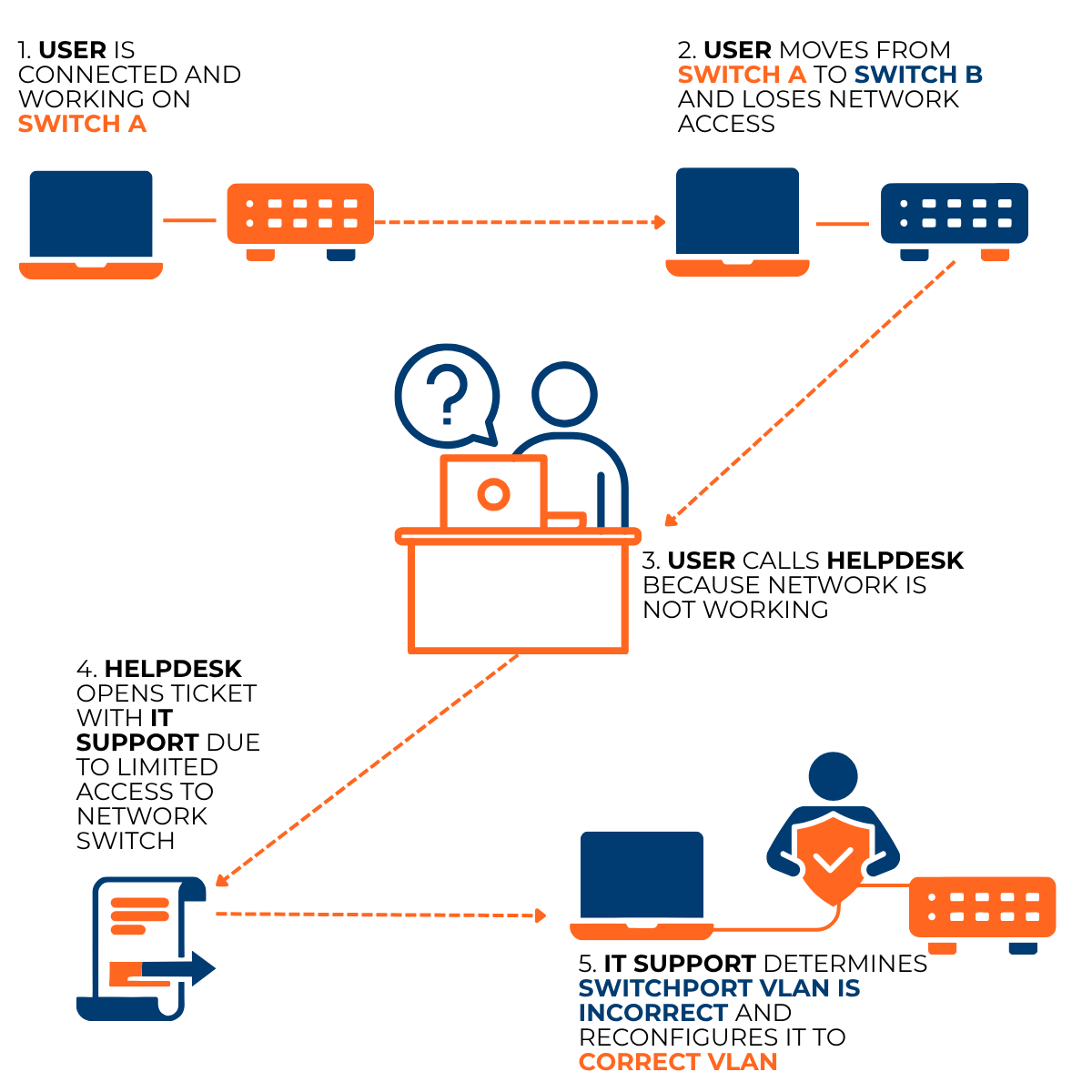
Figure 1. Pre-NAC wired troubleshooting workflow.
Before NAC: troubleshoot the port and reconstruct context
- A user moves to a new location, connects to the wired network, and cannot reach the expected resources.
- Helpdesk asks when the connection last worked and collects the IP address, subnet mask, default gateway, and MAC address.
- Helpdesk tests internet and internal connectivity, then escalates when the cause is still unclear.
- A network engineer signs in to the access switch and finds that the port is assigned to the wrong VLAN.
- The engineer updates the VLAN, resets the port, verifies connectivity, and closes the ticket.
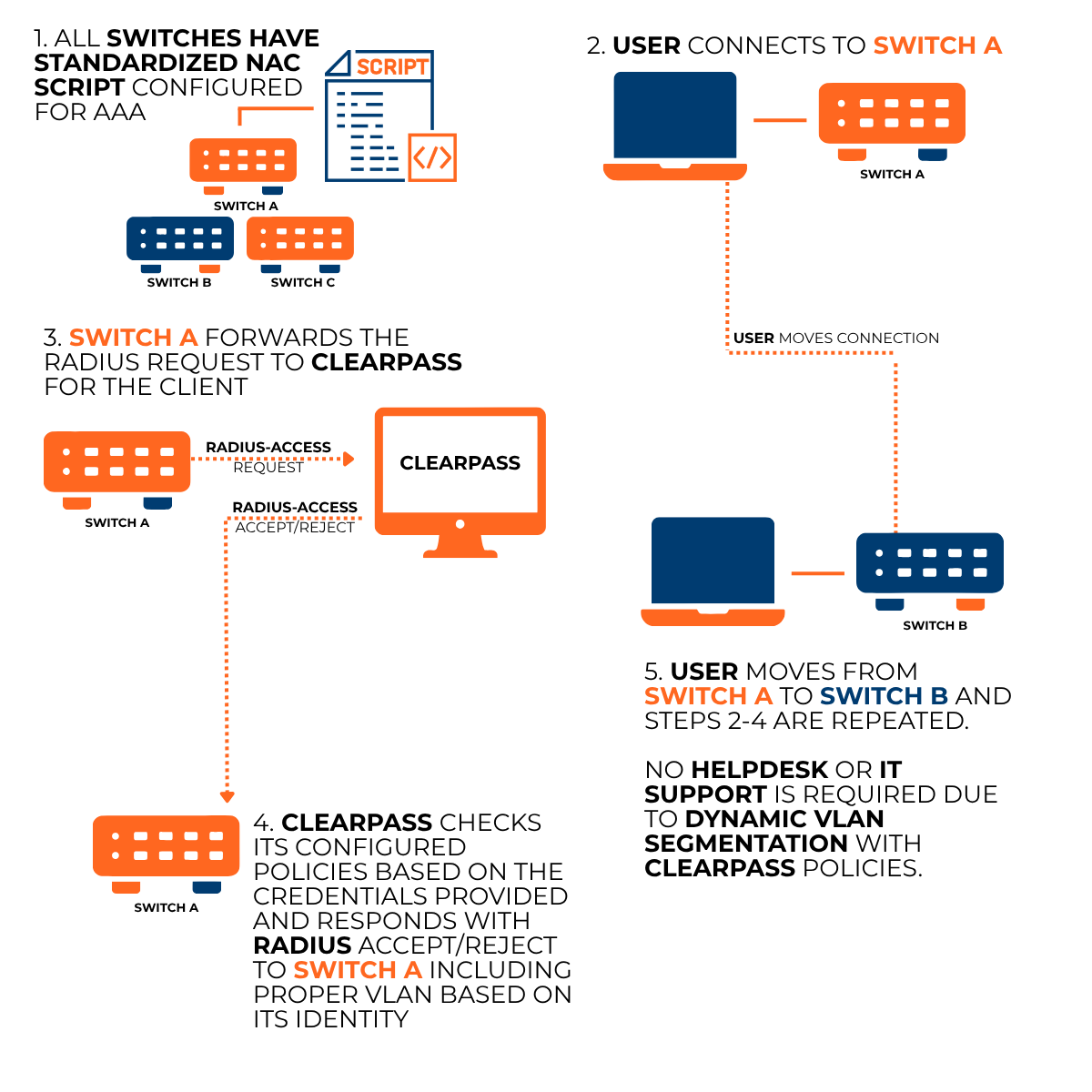
With NAC: let identity and policy drive the connection
- The access switch uses a standardized configuration that forwards the authentication exchange to the NAC platform.
- The endpoint presents an identity through the configured authentication method.
- The NAC platform evaluates the request against policy and, where configured, validates identity through a connected directory service.
- The switch receives the authorization result and applies the assigned role, VLAN, or enforcement profile.
- The administrator can review the access transaction in the NAC logs to confirm the result or investigate a failure.
What we found: the operational difference is context
In the pre-NAC workflow, the team reconstructs the problem after the user reports it. The engineer must identify the port, review its configuration, determine what the endpoint should receive, and make a manual correction. In the NAC workflow, identity, policy evaluation, and the authorization result are part of the original connection transaction.
That shift changes more than troubleshooting. It creates a repeatable foundation for access decisions across locations and device types. It also gives the team a central record of why access was granted, restricted, or denied, which is useful when validating policy behavior and narrowing down connection failures.
The practical takeaway?
NAC is most useful when the goal is not simply to authenticate a device, but to make the resulting access decision consistent, visible, and easier to operate.
What we’d recommend: plan the policy before the rollout
Start with discovery. The technology can only enforce decisions that the organization has defined. Before selecting policies or sizing a platform, document the identities, device groups, authentication methods, access outcomes, and integrations that matter in the environment.
1. Select the deployment model
Question: Can the organization support NAC on premises, or would a virtual, cloud-based, or hybrid architecture better fit the available infrastructure and operating model?
Objective: Choose an architecture the team can support and maintain.
2. Estimate concurrent clients
Question: How many corporate endpoints, BYOD devices, guests, printers, IP phones, and IoT devices connect across wired and wireless networks?
Objective: Create a supportable sizing and licensing estimate.
3. Define production access
Question: Which VLANs, ACLs, roles, and application restrictions should apply to managed corporate devices?
Objective: Translate business and security requirements into authorization outcomes.
4. Define BYOD and guest access
Question: Should personal and guest devices use self-registration, sponsor approval, internet-only access, restricted VLANs, or limited permissions?
Objective: Create distinct onboarding and access paths for non-corporate endpoints.
5. Choose authentication methods
Question: Which devices can use 802.1X, certificate-based authentication, MAC Authentication Bypass, or a captive portal?
Objective: Match authentication strength and usability to each endpoint category.
6. Identify useful integrations
Question: Which endpoint management or security systems can provide posture, compliance, risk, or ownership context?
Objective: Use relevant context to improve policy decisions without collecting data that will not be acted on.
Key takeaways
- NAC gives IT teams a centralized way to identify connections and apply access based on policy.
- Authentication, authorization, and accounting provide the foundation for identity-aware access decisions and troubleshooting context.
- Colorless ports and dynamic policy can reduce dependence on static switchport configurations and device-specific SSIDs.
- A focused pilot helps the team validate authentication, policy behavior, and operations before a broader rollout.
- Successful NAC projects begin with clear access requirements, authentication methods, endpoint categories, and ownership.
Network access control moves the network away from location-based assumptions and toward identity-aware, policy-driven decisions. The strongest outcome is not a longer feature list. It is a network where the team can see who or what connected, understand why a specific access result was applied, and adjust policy without rebuilding the operating model around manual port changes.
Ready to Connect?
Contact Us Today
Laketec's culture is built on ownership, integrity and collaboration, shaping how we work with each other and how we deliver lasting results for our clients.
With teams supporting customers across Cleveland, Dayton, Cincinnati, Columbus, Detroit, and surrounding communities, we're close enough to understand your environment and responsive when support matters most.